
Start with a business problem

What’s getting
in your way?

Recognise a situation, examine possible causes and see the work that could help. You do not need to know the technical answer.

Prefer to choose a service?
01 / Starting point

Our website needs to work better.

A website can look finished while leaving visitors unsure what you offer, struggling to use it or sending enquiries that your team cannot follow through. Start with the job it needs to do.

What might be happening

  • The offer and next step may be hard to understand.
  • Navigation, mobile layouts or forms may get in the visitor’s way.
  • The customer-facing site may be disconnected from the work after an enquiry.
What Suspicious could examine
  • Follow a visitor’s essential journey and inspect the actual pages and forms.
  • Review the content, visual hierarchy, speed, accessibility and editing needs.
  • Trace what the team receives and does after an enquiry.
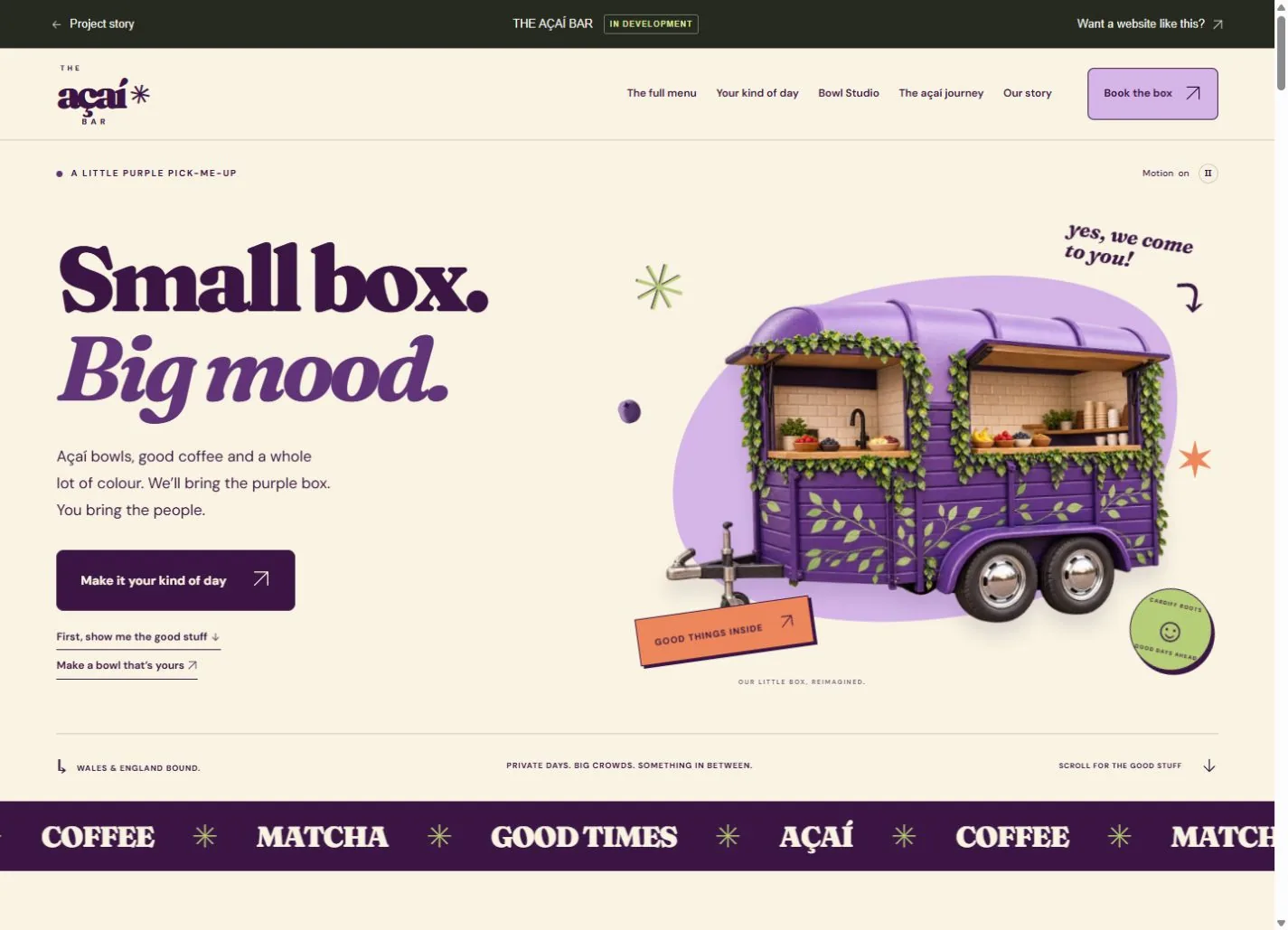
The Açaí Bar website preview: expressive typography and a purple horsebox composition.
The Açaí Bar · Client website in development

Work you could commission

  • A focused website and enquiry-journey review.
  • A new website, redesign or repair of the important pages.
  • A visual direction, digital graphics or connected enquiry feature.

What you could receive

  • A clear page structure and agreed changes.
  • Responsive designs, graphics and scoped working pages.
  • An enquiry journey with the required records and handover explained.

What this helps with

  • Visitors can understand the offer and find the relevant next action.
  • The team receives more useful enquiry context instead of an isolated message.
A realistic example

A service website explains who each service suits, captures the information needed for a first conversation and creates a useful follow-up record.

Illustrative work, not a client result.
Before choosing the work

A rebuild is not always needed. Content, existing URLs, domain/email continuity and ongoing editing belong in the scope; no ranking or conversion increase is promised.
02 / Starting point

We need a tool for this job.

You know the task, but the spreadsheet, workaround or available software does not fit it. Work out the users, information and actions before deciding what should be built.

What might be happening

  • Existing tools may leave an important gap in the workflow.
  • Information may be scattered across copies that are hard to keep consistent.
  • A new product idea may need a usable prototype before a larger commitment.
What Suspicious could examine
  • Follow the job with the people who perform it and identify the essential actions.
  • Compare an existing product, a small extension and a custom application.
  • Establish the data, permissions, connections and operating needs.
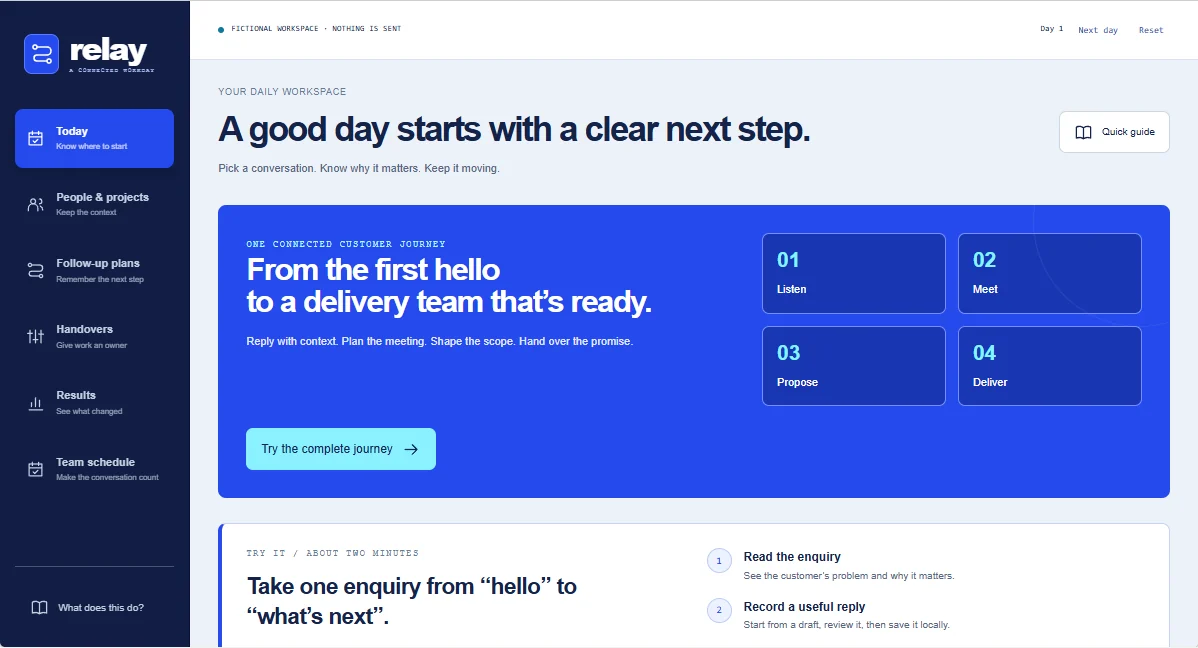
Relay workspace design with a daily view, follow-up plans and sample activity.
Relay · Fictional workspace with sample data and values. A design and application demonstration.

Work you could commission

  • A workflow and application plan.
  • A focused prototype, internal tool, portal or dashboard.
  • A full-stack application with scoped APIs and cloud setup.

What you could receive

  • Agreed user journeys and application/data structure.
  • Working features, interfaces and appropriate validation.
  • Testing, documentation and a clear plan for deployment and support.

What this helps with

  • People can do the defined job in a tool shaped around the actual work.
  • Records and actions have a clearer place instead of another manual workaround.
A realistic example

An internal tool lets a team record a request once, assign it, update its status and show the customer the relevant progress.

Illustrative work, not a client result.
Before choosing the work

A prototype answers a scoped question. Permissions, data protection, migration, reliability and production support requirements must be agreed for a working service.

03 / Starting point

We keep doing this manually.

People copy the same information, assemble the same report or repeat the same checks. Some of that work may be removable; some needs a clear rule, a better connection or useful assistance.

What might be happening

  • Two systems may require duplicate entry.
  • The process may include a step that no longer serves a useful purpose.
  • Varied inputs or unclear exceptions may prevent a simple fixed workflow.
What Suspicious could examine
  • Observe one task, including the corrections and exceptional cases.
  • Establish volume, time spent, checking effort and the next person who acts.
  • Compare removing the step, connecting tools, using rules and using AI.

Work you could commission

  • A process review and practical improvement plan.
  • A recurring report, data connection or rules-based workflow.
  • A narrow document-processing or AI-assisted task with review.

What you could receive

  • A mapped task and agreed change.
  • A scoped working workflow with validation and exception handling.
  • Operating notes and a way to compare the result with the current work.

What this helps with

  • People can stop repeating agreed routine handling.
  • Exceptions become visible rather than disappearing inside a background task.
A realistic example

An approved record produces a recurring report automatically, while missing or inconsistent information goes to a named person for correction.

Illustrative work, not a client result.
Before choosing the work

Low volume, frequent changes or heavy checking can make automation a poor trade-off. Expected benefit includes maintenance and review effort, not just build cost.

04 / Starting point

Our systems don’t talk to each other.

The team has become the connection between the website, CRM, spreadsheets and other software. An integration needs to move the right information and make an unsuccessful handover visible.

What might be happening

  • The products may not have a suitable API or export route.
  • Fields, identifiers or rules may mean different things in different systems.
  • Updates may create duplicates or arrive without enough information to act.
What Suspicious could examine
  • Identify the source, destination, trigger and action that should follow.
  • Check access, APIs, field formats, limits and the quality of current data.
  • Work through duplicates, missing fields, timeouts and manual recovery.

Work you could commission

  • An integration feasibility review and data map.
  • A scoped system/API connection.
  • A connected workflow with safe retries and useful failure visibility.

What you could receive

  • Agreed field mappings and handover rules.
  • A working connection or a clear technical prototype.
  • Validation, duplicate protection and recovery instructions.

What this helps with

  • The same record can move through the work without repeated retyping.
  • People can see what was delivered, what failed and what needs attention.
A realistic example

A valid website enquiry creates one CRM opportunity and the appropriate follow-up task; incomplete input is returned for correction instead of silently copied.

Illustrative work, not a client result.
Before choosing the work

Not every product exposes the connection needed. A successful API response does not prove that a person has acted on the record.

05 / Starting point

We don’t know how to use AI properly.

Start with a useful task rather than a demand to add AI everywhere. A support assistant, knowledge system or coordinated workflow needs clear source information, allowed actions and a way to judge its output.

What might be happening

  • The proposed use may be too broad to test meaningfully.
  • The system may lack reliable source information or an appropriate review step.
  • A model may be asked to make decisions that a rule or accountable person should make.
What Suspicious could examine
  • Define the task, inputs, desired output and unacceptable outcomes.
  • Compare straightforward software with AI assistance.
  • Check sources, access, evaluation examples, tool permissions and running costs.

Work you could commission

  • An AI use-case review and a narrow prototype.
  • A knowledge, FAQ or customer-support assistant.
  • A bounded agentic workflow, including approved tool use and human checkpoints.

What you could receive

  • A task definition and evidence-based implementation choice.
  • Scoped assistance with sources, checks and an escalation route.
  • Evaluation cases, activity visibility and operating/handover notes.

What this helps with

  • Assistance can handle suitable varied information without pretending every output is verified.
  • The business can judge a practical task before expanding the system.
A realistic example

An assistant uses approved company information to prepare a response, shows its source and hands uncertain or consequential questions to a person.

Illustrative work, not a client result.
Before choosing the work

A local demonstration is not a production AI service. Human judgement, data access, evaluation and action limits remain explicit; a chatbot is not automatically an agentic system.

06 / Starting point

We need more relevant sales conversations.

The useful goal is a conversation with someone whose needs fit the offer. Targeting, research, messaging, outreach and qualification are different pieces of work; a CRM should help the next action happen.

What might be happening

  • The campaign may reach people who do not fit the offer.
  • The message may not give the prospect a relevant reason to respond.
  • Responses and follow-up may depend on memory or unclear responsibilities.
What Suspicious could examine
  • Review the offer, target market and what makes a useful opportunity.
  • Inspect existing outreach, responses and qualification questions.
  • Follow a response through the campaign, CRM and sales handover.

Work you could commission

  • A researched targeting and messaging plan.
  • A defined outreach campaign with human execution and first-stage qualification.
  • A follow-up/CRM improvement or practical team training.

What you could receive

  • Target criteria and useful company/prospect research.
  • Relevant messaging, a scoped cadence and campaign records.
  • Human-reviewed conversation notes and clear next actions.

What this helps with

  • The team has a reasoned approach to who it contacts and why.
  • Useful responses can move into a sales conversation instead of losing momentum between tools or people.
A realistic example

A campaign focuses on an agreed customer profile, researches relevant people, uses an appropriate sequence and hands qualified interest to the sales owner with context.

Illustrative work, not a client result.
Before choosing the work

A campaign can be scoped by work and period without inventing a fixed package. No lead volume, revenue or closed sale is guaranteed.

07 / Starting point

We don’t know who to target.

A long contact list is not a target market. Work out which businesses the offer suits, who matters inside them and what would make an approach relevant before choosing a campaign.

What might be happening

  • The offer may be described too broadly to identify a useful customer profile.
  • Contact lists may prioritise available names rather than a genuine fit.
  • Research may not connect company needs with the people responsible for them.
What Suspicious could examine
  • Clarify the offer, suitable customer and reasons it matters.
  • Compare candidate market segments and practical ways to reach them.
  • Research companies, relevant roles and the information needed for qualification.

Work you could commission

  • Market and ideal-customer-profile research.
  • Company/prospect research and an outreach strategy.
  • Positioning and messaging work for a defined target group.

What you could receive

  • A reasoned target profile and qualification criteria.
  • A researched company/prospect approach and prioritisation.
  • Relevant messaging and recommendations for the next campaign.

What this helps with

  • Outreach has a clearer commercial reason than “we found their email”.
  • Time can be directed toward people and organisations whose needs fit the offer.
A realistic example

A business chooses a defined market segment, identifies the people responsible for the relevant problem and prepares an approach tied to those needs.

Illustrative work, not a client result.
Before choosing the work

Research supports commercial judgement; it does not establish that every prospect is interested or guarantee a sale.

08 / Starting point

We need someone suitable for this role.

Start with what the person needs to achieve and the evidence that would show they can do it. Sourcing and first-stage qualification can give the client a focused shortlist instead of another stack of applications.

What might be happening

  • The role may lack clear responsibilities or practical selection criteria.
  • Advertising or outreach may not reach the relevant candidates.
  • The business may lack time for sourcing, initial conversations and qualification.
What Suspicious could examine
  • Discuss the role, responsibilities, necessary experience and practical constraints.
  • Agree sourcing routes and consistent assessment criteria.
  • Identify who interviews, who makes the hiring decision and what a useful shortlist contains.

Work you could commission

  • A role brief and candidate-sourcing plan.
  • A candidate sourcing and first-stage qualification campaign.
  • First-stage applicant review and human-led candidate interviews.

What you could receive

  • An agreed role brief and assessment criteria.
  • Sourced candidates with human-reviewed assessments.
  • A relevant shortlist and clear handover to the client.

What this helps with

  • The client spends less of its own time on sourcing and initial qualification.
  • Hiring conversations start with evidence against a clearer role brief.
A realistic example

A vague technical vacancy becomes an agreed brief, a focused search and first-stage interviews, followed by candidate assessments for the client to review.

Illustrative work, not a client result.
Before choosing the work

The client makes the hiring decision. No placement, vacancy or autonomous AI employment decision is promised.

09 / Starting point

Our recruitment process is a mess.

Applicants, interview notes and decisions may be spread across inboxes and spreadsheets. Make the candidate journey and human responsibilities clear before adding another tool or automating the delay.

What might be happening

  • Stages and decision-makers may not be clear.
  • Candidate information and interview feedback may be difficult to find together.
  • Candidates may receive inconsistent updates or wait while an unowned handover stalls.
What Suspicious could examine
  • Follow a candidate from first contact through screening and decision.
  • Review the information, criteria and person responsible at each stage.
  • Identify repeated handling, missing feedback and useful candidate communications.

Work you could commission

  • A recruitment-process review and stage redesign.
  • Structured first-stage screening and candidate updates.
  • A supporting application or bounded automation for applicant organisation.

What you could receive

  • Clear stages, assessment criteria and responsibilities.
  • Useful records, screening material and communication templates.
  • Scoped tools or workflows with human review and exception handling.

What this helps with

  • Candidates and decision-makers can understand the next step.
  • The team spends less time reconstructing applications and chasing missing feedback.
A realistic example

Applications and first-stage notes are organised against the agreed role, missing information is flagged and a person decides how the candidate proceeds.

Illustrative work, not a client result.
Before choosing the work

Technology can organise and assist agreed steps. People apply the criteria and make employment decisions; no automated ranking is treated as an unquestionable decision.

10 / Starting point

Customers are having a poor experience.

A difficult interaction may come from confusing information, unhelpful replies, a slow internal handover or a process that makes promises the team cannot keep. Review the service and the work behind it together.

What might be happening

  • Customers may not know what happens next or receive consistent answers.
  • Complaints and exceptions may lack a useful escalation route.
  • Staff may be working around unclear processes or need practical communication training.
What Suspicious could examine
  • Review a real customer journey, including difficult contacts and service recovery.
  • Listen to the team’s handling process and examine replies, expectations and handovers.
  • Separate a communication/training issue from a website, knowledge or system problem.

Work you could commission

  • A customer-service and process review.
  • Clearer replies, escalation rules and practical team training.
  • A better digital journey or source-based support assistant where appropriate.

What you could receive

  • A clear account of where the experience breaks down.
  • Usable response guidance, escalation steps and training material.
  • Agreed website, knowledge or workflow improvements where these address the cause.

What this helps with

  • Customers can receive clearer expectations and a useful response.
  • Staff have practical ways to resolve common issues and escalate the difficult ones.
A realistic example

A service review finds that customers repeat the same information to different teams; the response guidance and handover are redesigned before considering a chatbot.

Illustrative work, not a client result.
Before choosing the work

A chatbot fits repetitive questions with suitable source answers, not every complaint or judgement-heavy conversation. Agree the service process, team involvement and expected outputs before the work begins.

11 / Starting point

We’ve grown, but our processes haven’t.

A workflow that worked for a small team may now depend on informal knowledge, repeated chasing and fragile spreadsheets. Find which handovers and decisions need to change as the work grows.

What might be happening

  • Responsibilities may have become unclear as more people join the work.
  • Informal approvals or duplicate records may create recurring delays.
  • Tools, reporting and team roles may not reflect the current workload.
What Suspicious could examine
  • Follow representative work across teams and identify delays and corrections.
  • Review responsibilities, communication, information sources and reporting.
  • Compare process changes, training, existing software, custom tools and staffing needs.

Work you could commission

  • A focused operational review and priorities plan.
  • A redesigned workflow with clearer responsibilities and implementation support.
  • A scoped internal tool, integration or automation where the agreed process needs it.

What you could receive

  • Current and proposed workflow maps with practical decisions.
  • Clear roles, handovers and working instructions.
  • Agreed improvements and a way to review their use.

What this helps with

  • People can see the next action without relying on unwritten knowledge.
  • Repeated chasing and duplicate handling can be reduced at the points that actually cause them.
A realistic example

An enquiry-to-delivery process is mapped, duplicate entry removed and each stage given a clear next action before a dashboard or automation is built.

Illustrative work, not a client result.
Before choosing the work

New software alone cannot resolve conflicting priorities or unclear responsibilities. Scope follows the actual work, rather than a promise to transform the whole business.

12 / Starting point

We bought software but nobody uses it properly.

The software may be a poor fit, difficult to use or disconnected from how the team works. It may also need configuration, clearer instructions or training rather than replacement.

What might be happening

  • The product may not support the essential workflow as expected.
  • Configuration, permissions or data may make everyday use awkward.
  • Staff may not understand when to use it or what happens to their work afterward.
What Suspicious could examine
  • Observe the job and compare intended use with what people actually do.
  • Review configuration, integrations, information quality and user difficulties.
  • Distinguish product mismatch, process design and practical training needs.

Work you could commission

  • A software-use and workflow review.
  • Configuration, simplification and practical adoption training.
  • A small integration or supporting tool if a specific gap remains.

What you could receive

  • An account of the mismatch and prioritised changes.
  • Usable configuration or a simplified workflow.
  • Task-specific instructions and training, with any technical changes scoped separately.

What this helps with

  • The team can understand how the software helps its actual job.
  • Existing investment can be assessed and used more sensibly before buying or building another system.
A realistic example

A CRM review finds unclear stages and confusing record requirements; stages are simplified and the team practises real follow-up tasks before replacement is considered.

Illustrative work, not a client result.
Before choosing the work

Not every adoption problem needs custom software. The review may recommend keeping, configuring, extending or replacing a product according to the evidence.

13 / Starting point

Enquiries come in and then disappear.

The website may capture a message without giving the team a useful record, clear responsibility or an appropriate follow-up. Trace the enquiry from the visitor through to the next real conversation.

What might be happening

  • The form may collect too little useful context or fail to deliver visibly.
  • The enquiry may be copied between inboxes, spreadsheets and the CRM.
  • Qualification and follow-up may lack a next action or an owner.
What Suspicious could examine
  • Send and trace a representative enquiry through the current system.
  • Check form information, delivery, CRM records and duplicate handling.
  • Review qualification, response material and who follows the opportunity.

Work you could commission

  • An enquiry-journey and follow-up review.
  • A clearer form with a scoped application/CRM connection.
  • A qualification and sales follow-up process, with suitable automation.

What you could receive

  • A defined visitor-to-team journey.
  • Useful enquiry records with validation and visible delivery/failure behaviour.
  • Qualification questions, follow-up material and owned next actions.

What this helps with

  • The team can find the enquiry, its context and the next useful step together.
  • Interest has a clearer route into a human conversation instead of relying on somebody remembering it.
A realistic example

A website request creates a single opportunity record, alerts the right person and attaches the agreed qualification task; delivery failures remain visible for recovery.

Illustrative work, not a client result.
Before choosing the work

A delivered enquiry is not a qualified opportunity or a sale. Existing tools, access and the person responsible for follow-up determine what should be connected.

14 / Starting point

We don’t know what the actual problem is.

Start with something concrete: one frustrating task, one customer journey or one lost handover. A review can compare possible causes and help choose a useful next action without requiring a technical brief.

What might be happening

  • Several symptoms may share a process, communication or responsibility problem.
  • A requested tool may address only the visible part of the work.
  • The team may lack a shared picture of what happens across functions.
What Suspicious could examine
  • Ask the people doing the work to show a representative example.
  • Trace the customer, commercial and internal steps involved.
  • Compare possible causes, existing options and a proportionate intervention.

Work you could commission

  • A focused business or process review.
  • A practical options and priorities plan.
  • Support to implement an agreed process, training or technical change.

What you could receive

  • A clear account of the observed work and questions still open.
  • Prioritised recommendations with reasons and dependencies.
  • A proposed next step, including what it would involve and deliver.

What this helps with

  • The business can decide what to address before committing to a guessed solution.
  • A conversation can connect people, commercial work and technology instead of treating them as separate problems.
A realistic example

What begins as “we need AI” may turn out to need clearer information, a simple system connection or a better handover; the review establishes which is worth pursuing.

Illustrative work, not a client result.
Before choosing the work

A website selection is not a diagnosis. Recommendations require the real work and context; a review does not assume a larger implementation will follow.

A useful first conversation

Can’t see your exact situation?

Describe one real task or customer journey. We can work through where it gets difficult.

Talk to Suspicious

Tab to a result. Enter to open. Escape to close.

SUSPICIOUS INC.START A CONVERSATION

01 / THE STARTING POINT

What needs to change?

A new idea, a stubborn problem, or a few things that should work better together.

Where shall we start? Choose any that fit

Not sure yet? Leave these blank. We’ll work it out together.

What’s happening now, and what would better look like?

01 / 03